
Welcome to the Mathematical World!
Ataullah Rashidi (Aṭāullāh Rushdī bin Aḥmad Maʿmār; 17th century)
Mughal-era Mathematician, Translator, and Architect
Ataullah Rashidi was a Mughal-era mathematician, translator, and architect, known for bridging Arabic, Sanskrit, and Persian mathematical traditions. Born into a family of master builders, he was the eldest son of Ustad Ahmad Lahori, chief architect of the Taj Mahal. He and his brothers were trained in architecture and mathematics, combining practical geometry with scholarly work in arithmetic, algebra, and mensuration.
Mathematical Works and Translations
Ataullah is best known for two Persian works that transmitted important mathematical knowledge across linguistic and cultural boundaries:
- Khulāṣat-ul Rāz: an abridged Persian verse translation of the Arabic Khulāṣat al-Hisāb, covering arithmetic, algebra, and mensuration. Dedicated to Prince Dārā Shikōh.
- Tarjumaʿ-i Bījganit: a Persian translation of Bhāskara II’s Bijaganita (Algebra, 1044 AH / 1634–35 CE), dedicated to Emperor Shah Jahan. This work introduced quadratic and indeterminate equations, surds, and kuttaka-style algorithms into Mughal scholarly networks.
Architectural Context
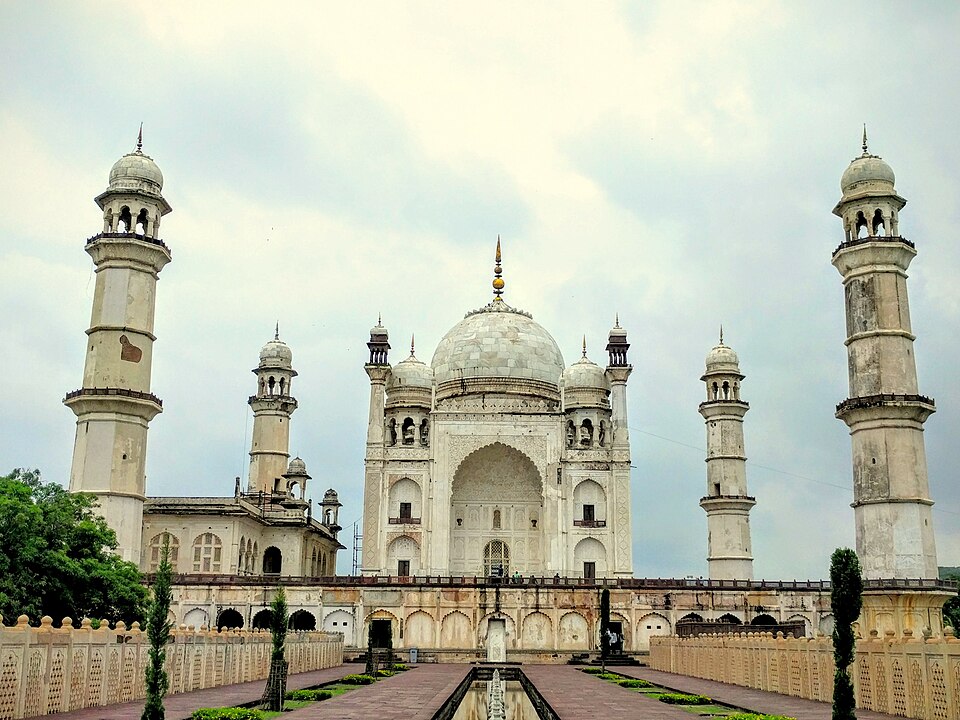
Ataullah’s mathematical expertise informed his architectural projects, notably in Shahjahanabad (Old Delhi) and the Bibi-ka-Maqbara in Aurangabad (1660–61). His works reflect mastery of proportional canons, mensuration, and geometric design, bridging theory and practice.
Representative Mathematical Techniques
His translations transmitted practical rules used in surveying, trade, and architecture, including:
- Arithmetic & Algebra (Khulāṣat-ul Rāz): fractional operations, extraction of roots, rules of three, quadratic problems, mensuration of polygons and solids.
- Core Algebra (Tarjumaʿ-i Bījganit): procedures for quadratic and simple indeterminate equations, manipulation of surds, kuttaka-style algorithms.
Typical quadratic formula (as transmitted):
\
Legacy and Significance
- Knowledge transmission: Standardized algebra and computation for Mughal students, artisans, and administrators.
- Family school of math-architecture: Combined design practice with textual mathematics alongside his brother Lutfullah Muhandis.
- Material footprint: Contributions to Bibi-ka-Maqbara and other projects demonstrate the lived application of algebra and geometry in Mughal architecture.

All rights reserved by the Mathematical Unity
Contact: +8801400044645
Email: mathematicalhorse1453@gmail.com
Our Discord Server: Mathematical Unity [Ulus Riyadiyat]